

- Search
 Lot I-10-7, D7 Street, Saigon Hi-Tech Park, Tang Nhon Phu Ward, Thu Duc City, HCMC
 (+84) 28 7301 3688
 Info@wembleymed.com.vn
DR. DOAN HONG HA


In the context of intravenous (IV) infusion being one of the most frequently performed procedures in healthcare facilities, the requirements for IV catheters go beyond clinical effectiveness. They must also ensure the safety of healthcare workers and patients. MEDCATH Safety IV Catheters, manufactured at the WEMBLEY MEDICAL factory, is a solution that directly addresses this growing trend.
The intravenous catheter (IV catheter) is one of the inventions that has had a profound impact on modern medicine. Its development has been closely associated with the need to deliver medications and infusion fluids directly into the circulatory system in a rapid, accurate, and safe manner.
In 1832, Thomas Latta was the first to administer saline solution intravenously to treat cholera, marking an important clinical milestone in the development of IV therapy. The devices used at that time were still very rudimentary, often made of metal, with a high risk of infection and vascular injury.
At the beginning of the 20th century, hollow metal needles became widely used. However, rigid metal needles were difficult to secure and could easily damage the vessel wall if the patient moved. The need to keep the needle in place throughout the infusion period continued to expose patients to discomfort and potential complications.
By around the 1950s, biomedical plastics such as Teflon and polyurethane began to be more widely adopted in healthcare. The combination of a steel needle with a flexible plastic catheter represented an important advancement in IV catheter design. The needle was used to puncture the vein and guide the catheter into position. Once the catheter was correctly positioned, the needle was withdrawn, leaving only the flexible catheter inside the vessel.
This advancement helped:
Reduce vascular trauma.
Allow prolonged IV infusion.
Improve patient comfort.
From approximately the 1970s to the 1990s, IV catheters became increasingly standardized in terms of size, Gauge (G) designation, and color coding.
For example:
23G: outer diameter of approximately 0.6 mm.
14G: outer diameter of approximately 2.1 mm.
Catheter colors were also adopted to facilitate the rapid identification of catheter size and intended clinical use. Standardization made it easier for healthcare workers to select and use the appropriate product for different clinical situations. For example, gray catheters are commonly used for blood transfusion, while pink catheters are commonly used for routine IV infusion, depending on clinical practice and product standards.

Since the 1990s, safety in the use of sharps has received increasing attention. The risk of needlestick injuries during handling, needle withdrawal, and post-use disposal has driven the development of safety IV catheters.
Key innovations have focused on:
Automatic needle-shielding mechanisms activated after needle withdrawal.
Reducing the risk of exposure to bloodborne pathogens, particularly HIV, hepatitis B, and hepatitis C.
Compliance with occupational safety standards in healthcare settings.
Safety IV catheters have increasingly been adopted by healthcare facilities and have become an important solution in strategies to prevent occupational injuries caused by sharps.
Catheter materials are becoming softer and more biocompatible, while catheter designs are increasingly optimized to improve flow, reduce phlebitis, and minimize catheter occlusion.
These developments are also being integrated with:
Closed infusion systems.
Infection control measures.
Patient safety protocols.
Several studies and reports on occupational exposure to infectious diseases through needlestick injuries indicate that, among high-risk occupational groups worldwide, including healthcare workers in Vietnam, approximately 40% of exposures are associated with hepatitis B, 40% with hepatitis C, and around 2.5% with HIV following needlestick injuries.
Systematic studies have shown that healthcare workers in Vietnam face a significant risk of needlestick injuries, with a considerable proportion of incidents going unreported. One study reported that approximately 64.8% of healthcare workers experienced at least one sharps injury per year in certain hospitals in Hanoi.
Needlestick injuries represent a serious occupational hazard and may result in exposure to bloodborne pathogens.
The risk of HIV transmission alone can have a profound impact on healthcare workers and their families. Following occupational exposure to HIV through a needlestick injury, post-exposure management and follow-up can be complex:
The source of potential infection must be identified whenever possible.
The healthcare worker must undergo testing to establish their current infection status.
HIV post-exposure prophylaxis (PEP) with a three-drug antiretroviral regimen may be required for 28 days.
The medication may cause adverse effects such as headache, dizziness, fatigue, and loss of appetite.
Follow-up testing and monitoring may be required for an additional 3 - 6 months.
If HIV infection is subsequently confirmed, the consequences can be devastating.
Needlestick injuries involving the needle of an IV catheter are among the occupational risks commonly encountered in healthcare settings. Although post-exposure protocols are available, they are essentially reactive measures. In contrast, prevention through the use of safety-engineered devices provides a more sustainable and effective approach.

MEDCATH Safety IV Catheters is designed with an automatic needle-shielding or locking mechanism that activates immediately after needle withdrawal, helping to:
Prevent accidental needlestick injuries.
Limit direct contact with a contaminated needle.
Significantly reduce occupational incidents associated with IV infusion procedures.
This solution does not rely solely on individual habits or experience. Instead, the safety mechanism is integrated into the product design, shifting the focus from responding to risks to preventing them at the point of use.
MEDCATH Safety IV Catheters, manufactured at WEMBLEY MEDICAL, is a modern product designed to meet international standards while offering cost-effective value. The entire manufacturing process is carried out using automated production lines in a Class 100,000 cleanroom and is controlled under quality management systems compliant with ISO 9001:2015, ISO 13485:2016, TCVN 7609-1:2007, TCVN 7609-5:2007, ISO 10555-1:2013, ISO 10555-5:2013, ISO 7394-2:2008, ISO 80369-7:2021, ISO 9626:2016, ISO 11135:2014, ISO 10993-7:2008, ISO 14001:2015, GMP, and the Vietnam High-Quality Goods standards.
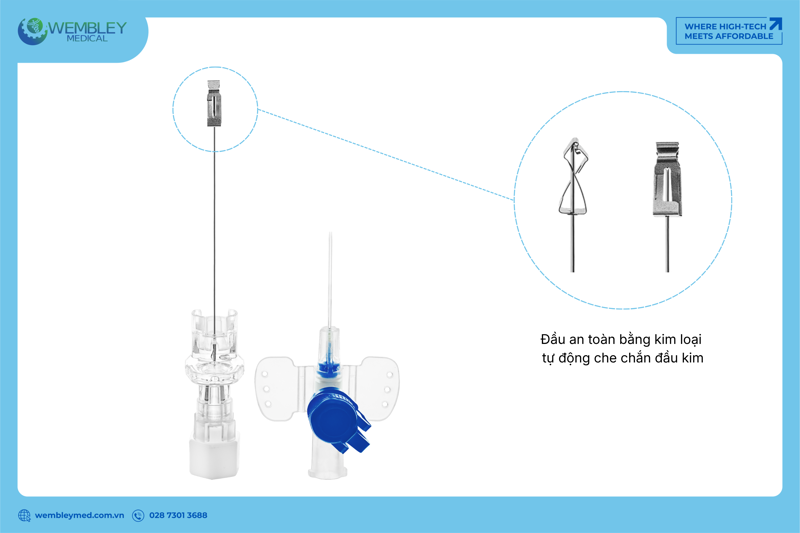
The adoption of safety IV catheters not only aims to protect healthcare workers but also contributes to establishing a safer and more standardized medical device utilization process.
Proactive protection for healthcare workers.
Reduced safety incidents and administrative burden.
Enhanced hospital image through improved clinical practices.
Alignment with the growing trend and increasingly stringent requirements for safety-engineered medical devices.
Manufactured in Vietnam: stable supply and shorter delivery lead times.
Cost-effective: optimized budgets for healthcare facilities and medical device procurement packages.
Technical support and comprehensive regulatory documentation: facilitating procurement and tendering processes.

With its safety-oriented design, consistent quality, compliance with international standards, and ability to meet practical clinical needs, MEDCATH Safety IV Catheters, manufactured by WEMBLEY MEDICAL, is a suitable choice for healthcare facilities seeking to minimize occupational risks, standardize clinical procedures, optimize costs, and improve the quality of patient care.


MEDCATH Safety IV Catheters are medical devices that administer fluids, and nutrients into a patient's vein. These catheters are designed to minimize the risk of vein rupture, improve patient mobility, reduce pain and infection risk, and ensure safety during nursing procedures.
Sources:
https://www.museohistoricodeenfermeria.org/lista_colecciones.php